SCI’S INTERNATIONAL SEAFARERS’ CENTER: A Hub for the Port Community
by Naomi Walkher, PhD.
Manager, Special Projects
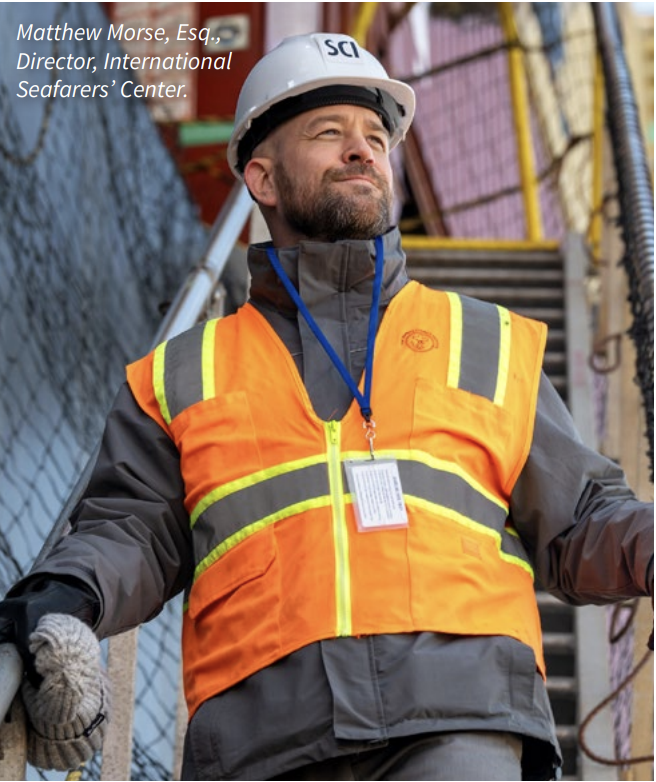
Matthew Morse, Esq. joined SCI as the Director of the International Seafarers’ Center in July 2024. He now also holds the role of Deputy Director of Operations for SCI. He was elected to the Board of the North American Maritime Ministry Association (NAMMA) in August 2026.
When he first started at the ISC, Matt Morse says he was impressed by the existing commitment to living out SCI’s overall mission. His focus has been multifaceted: supporting SCI Chaplains and staff in their work as SCI’s blue-water “boots on the ground,” raising greater awareness within and strengthening SCI’s relationship with a port community of tens of thousands of souls, enhancing processes and policies across the organization, and creating efficiencies throughout the SCI system. We talked to him recently to ask how his work at the ISC is going.
What are the opportunities presented in your roles?
I am privileged to wear several hats for SCI. As Deputy Director of Operations, I work with Director of Operations, Leslie O’Neal across the organization to contain or reduce costs, enhance services, and improve processes. As Director of the ISC specifically, I manage operations and staff and work on community engagement and outreach to the wider port and the broader geographical areas around us. Our President & Executive Director refers to this as “friendraising,” and I like that term.
The port, as a working environment, is unlike any other. It takes time and concerted effort to build community and trust, and our whole team has worked together to do this. My staff and I are proud to have broken through in both large and small ways. I’m happy to say that we have forged excellent, strong relationships with port representatives, the Port Authority, the Port Authority Police Department, shipping associations, and terminal representatives. Those relationships continue to strengthen as we earn trust over time. We are achieving this through consistently reaching out to different groups, attending events of and meetings for port constituents and the area maritime community, and making concerted efforts to nurture real, personal connections across all layers of a diverse and complex port community while emphasizing SCI’s inclusive, non-proselytizing care and amenities. The ISC is also increasingly and intentionally being used for community gatherings and celebrations such as Christmas, the International Day of the Seafarer, or our recent 9/11 memorial service.
Members of our wider community have noticed all this and told us that it’s great that SCI is actively reaching out to them. This in turn has increased our opportunities for collaborative work within the port; SCI feels increasingly welcome at the table. We serve seafarers most effectively when we serve the communities that daily interact with them and with us.
One of the special things about SCI in this setting is that our offerings come from a place of authentic care and selfless service. Transactional relationships are by nature common in the port, but SCI stands apart from this because we are here for people rather than looking to extract something from them.
What are some of the challenges you face?
The ISC facility itself is large, complex, and demanding. It’s a challenge to consistently split focus between building outward-looking relationships, thinking holistically about organizational operational needs, and dealing with our facility’s significant requirements. More centrally to SCI’s overall mission, a real challenge is meaningfully meeting the needs of international seafarers in an age when shore leave is rarer and shorter than ever before. How does SCI through the ISC serve people who don’t necessarily have hours to spend in a center, but instead need to make the most of an increasingly brief chance to go ashore? We are constantly trying to be both creative and focused in our approach. And we are big believers in doing little, impactful things with great love and care.
To give one example of this: research has shown seafarers who are on vessels for long periods of time can experience nerve damage because of the vibrations of the vessel and the nature of their work. Working in concert with SCI’s Development team, the ISC secured funding for and installed a state-of-the-art massage chair in the ISC for free use. Seafarers can use it while connecting with their families or talking and laughing with their shipmates as they wait for transportation to take them to the mall. They are charged nothing and receive something of quietly impactful actual value. It meets a real need and respects their demanding schedules and has therefore been very popular so far.

To your point about the operational challenges of the center itself, what is the purpose and advantage of having a physical center within the port in the 21st century?
Great question. I believe the ISC operates as both hub and beacon. It is the only open facility in the whole
port, a neutral territory in what is by nature a siloed environment. Our port community can come to us for room rentals, for counseling, for recreation and fitness, and for authentic human connection. We are the place. We are both physically open to visitors, but also spiritually and emotionally open and accepting of everyone–no matter their job, faith, or background. We offer a welcome to everyone. There is great symbolic value in this, and the cultivation of a steady presence in our community makes our work more visible to, and vital to, those we interact with and serve every day.
Our physical space communicates to all that SCI is here and that it’s worth paying attention to the people we serve, because they’re important to everything that happens in the port environment. Seafarers are often “invisible” to the larger world. SCI is visible through the ISC and therefore that makes seafarers more visible.
How do you see SCI’s mission in action in the ISC: in your staff, in the chaplaincy side, and in operations?
To answer this, I thought the best thing would be to highlight the people on our ISC staff who are embodying SCI’s mission on a daily basis. I see SCI’s mission in how Chaplain Michelle McWilliams holds each seafarer with care in her heart, offers her experience at the center to help other staff members without question or hesitation, and spends free time assisting Christmas at Sea (“CaS”) Director Joanne Bartosik. I see it in Joanne’s tireless dedication to CaS and to the countless volunteers who send in their handmade items. I see it in how Father Bill Allport brings intentionality and care to each encounter between leaving the ISC and on the vessels themselves and in the ideas he generates. I see it in Father James Kollin’s heart for interfaith dialogue, his grounded presence with seafarers, and his efforts to be inclusive toward the communities we serve. I see it in the warmth of welcome that our daytime Admin, Janet Temchus, gives to every individual who walks through our doors. I see it in the pragmatic attention to detail and the care that
evening Admin Aileen Crisonino brings to her role. I see it in the willingness of Operations Associate Denise Davis to engage meaningfully with those she transports. I see it in the enthusiasm of new Operations Associate Anwar Afifi, and I see it in the dedication and good-humored energy that Facilities Associate William Mercer brings with him every day.